Showing posts with label Artificial Intelligence. Show all posts

Monday, August 4, 2025

AI Weather Forecasting

Back in March of 2024, I mentioned the new AI weather model developed by the world-leading European forecast center (ECMWF), and it's exciting now to be able to comment on a major recent upgrade to the ECMWF's AI forecasting technology.  In short, ECMWF has released a new version of their AI system (AIFS) that produces an ensemble of outcomes, similar to the ensemble output from traditional physics-based models.

https://www.ecmwf.int/en/about/media-centre/news/2025/ecmwfs-ensemble-ai-forecasts-become-operational

In many respects, this latest AI system is now significantly better than the ECMWF's own IFS (Integrated Forecasting System), the traditional physics-based model that has been developed over decades, and that grinds out its forecasts on large supercomputers.  In contrast, the AIFS is "data-driven", meaning it learns from the historical data with no computational constraint from the laws of physics; and its realtime forecasts run extremely quickly with a tiny fraction of the computing resources.

Here's a chart to illustrate the realtime performance of AIFS forecasts initialized from December 2024 through June 2025:


The AIFS-ENS model (black line) has the highest correlation of 30-90°N 500mb height anomalies, and for lead times beyond about a week it's dramatically better than the first AIFS version that had only a single ensemble member.

It's interesting to have a look at where on the globe the superior performance is to be found.  The maps below show the improvement of AIFS over the traditional IFS ensemble, measured in terms of the percentage change in variance explained for 500mb height at various lead times.  For instance, if the correlation coefficient improves from 0.8 to 0.85, that's a 13% improvement in variance explained.  Interestingly, the improvement seems to emerge first in the tropics at only 2-3 days into the forecasts, and then the higher latitude forecasts start to benefit - especially over the North Pacific and North America - after 4-5 days.


The spatial signals become very noisy at longer lead times because of the rather small sample size, but averaging the results across all longitudes reveals that the high latitudes see the most improvement beyond 7 days:


The significant improvement in the Arctic will be very encouraging for Alaska forecasters, because weather predictability is lowest in the high latitudes to begin with.  Redoing the first figure above for 60-90°N, we see a nice boost beyond 10 days (see below).  To be precise, the anomaly correlation at day 15 goes from +0.21 (IFS) to +0.27 (AIFS-ENS), and while that's still too low to be useful, it represents a 57% gain in variance explained.


It can't be overstated how remarkable it is to see performance gains like this from such young technology; presumably there is room for considerably more improvement in the years ahead.

Finally, readers may ask where the AIFS-ENS forecasts can be viewed?  Unfortunately, I'm not aware of any free websites that provide AIFS-ENS maps that include Alaska, with the exception of ECMWF's own site, and that's not particularly user-friendly:


https://charts.ecmwf.int/?facets=%7B%22Range%22%3A%5B%22Medium%20%2815%20days%29%22%5D%2C%22Type%22%3A%5B%22Forecasts%22%5D%2C%22Component%22%3A%5B%22Surface%22%2C%22Atmosphere%22%5D%2C%22Product%20type%22%3A%5B%22AIFS%20Ensemble%20forecast%22%5D%7D

I expect in due course the AIFS-ENS data will be added to sites like Tropical Tidbits, so check back there (under "Ensemble") occasionally.

Friday, March 1, 2024

ECMWF AI Forecasts

The weather industry has been abuzz with excitement in the past year about the new AI (Artificial Intelligence) forecast models; I penned a few comments back in November:


The latest news is that ECMWF is now providing the realtime forecast data from its AIFS model, and it's open and free for all to use.  You can see the 4 forecasts per day on Levi Cowan's website:


The skill of the model is comparable to the leading physics-based models, so the new data will provide a useful tool for forecasters.  I'll be keeping an eye on it for Alaska.

We should bear in mind, however, that ECMWF currently runs only a single AIFS forecast each time, rather than an ensemble of forecasts like the ECMWF, NOAA, and Canadian ensemble systems.  Ensemble forecasts provide valuable information on confidence ("how similar are the ensemble members?"), and the ensemble-average forecasts tend to be more stable from run to run.  The AIFS forecasts will have a tendency to jump around from run to run, so take each iteration with a pinch of salt.

For example, here are the 4 latest AIFS forecasts for the morning of March 11, i.e. 10 days ahead, and probably at or beyond the limit of deterministic predictability for the Alaska region.  From oldest to newest forecasts:


The general theme is the same - cold in northern Alaska - but the individual forecasts disagree on the extent of cold farther south.

For comparison, here's the NOAA GEFS ensemble mean for the same time.  In this case the overall agreement is pretty good; and these forecasts (GEFS vs AIFS) are produced by completely different methods.  Impressive technology for sure!


Wednesday, December 20, 2023

AI Forecast Follow-Up

Last month I penned a few comments on the big news in the weather industry: the emergence of AI models as a legitimate competitor to traditional physics-based models for weather forecasting.

To provide a more concrete example of the impressive performance of the new models, I pulled out forecasts for Fairbanks from two of the AI models that I've been running over the past couple of months.  Note how remarkable this is: the models can be run on pretty modest hardware; you don't need a supercomputer.

Here's a basic comparison of forecast skill for days 1-14 of the 2m temperature forecasts for Fairbanks (click to enlarge).  Here I'm using ERA5 reanalysis data as "ground truth".


The two AI models are GraphCast (Google) and FourCastNet (NVIDIA), and I'm running FourCastNet with 50 members based on the initial conditions in the ECMWF ensemble forecast.  GraphCast is more computationally demanding, so I only have a single member each day.  The usual (traditional) ECMWF and GEFS ensembles have 51 and 31 members respectively.

Remarkably, GraphCast's single forecast member equals the ECMWF ensemble skill out to 9 days.  The ECMWF ensemble is the gold standard for medium-range forecasting, so this is a terrific result that confirms the power of the new models.  In contrast, FourCastNet starts out strong but roughly equals GEFS after 5 days, with inferior skill.  Note that systematic bias could affect these results to some extent, as I used the ERA5 seasonal normal as the baseline, without any bias correction.

Looking at the mid-atmosphere 500mb height forecasts, it's interesting to note that GraphCast drops off significantly after 10 days, while FourCastNet shows a very strong performance.  This may be reflecting the benefit of an ensemble approach for the medium-range (7-14 day) forecast.


More results will be forthcoming when I have time.  In the meantime, here's the latest forecast I have access to: the message is "warmer than normal" in Fairbanks, and perhaps especially around Christmas Eve and New Year's Eve.


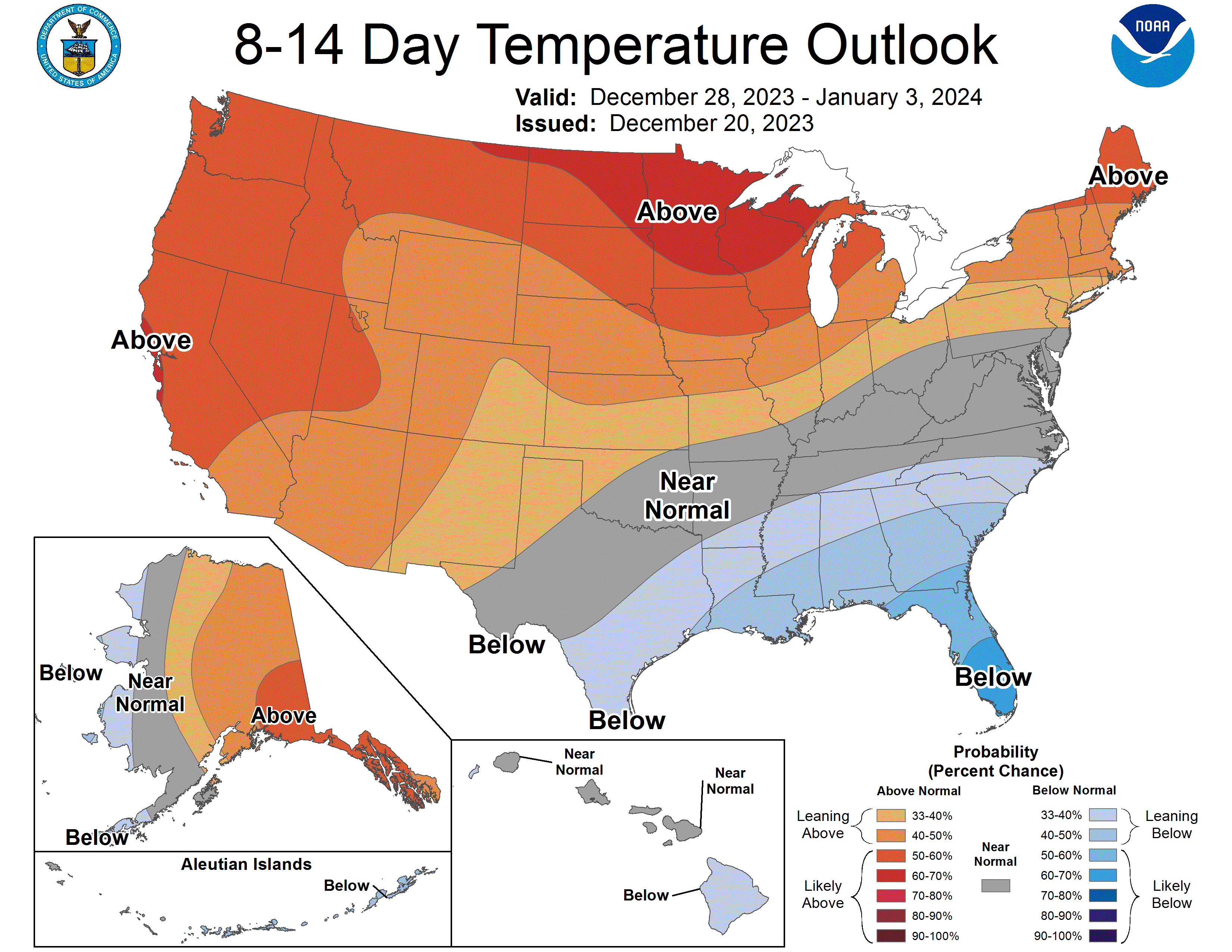
The CPC's 8-14 day forecast also calls for warmth for central and eastern Alaska around the New Year period.  It's a very typical El NiƱo pattern nationwide.


Monday, November 27, 2023

AI Weather Forecasts

I'm sure many readers have come across recent headlines about new breakthroughs in Artificial Intelligence for weather forecasting; here's one example:

https://arstechnica.com/science/2023/11/ai-outperforms-conventional-weather-forecasting-for-the-first-time-google-study/

It's not always easy to distinguish between hype and reality when it comes to claims of new technological advances.  Is the enthusiasm justified in this case?  Are weather forecasts about to see a revolutionary step forward in accuracy?  I'll offer a few words of my own perspective, as someone in the "weather business".

First, there's no doubt that AI and Machine Learning (closely related concepts) have made amazing strides for weather prediction in the past few years.  In early 2021, ECMWF (the world's leading "traditional" weather forecasting organization) published a "road map" for the future of AI weather forecasts, anticipating a rather gradual pace of innovation and change; but it turned out that several leading technology companies achieved remarkable success in just the next 2 years.  Crucially, the latest AI models were suddenly revealed as being able to match or even beat the ECMWF's forecast accuracy according to some metrics.  ECMWF wrote about it here:


The headline result - exceeding the ECMWF's basic skill level - is a big deal.  It means these new models are legitimate competitors, and it's truly remarkable that the AI scientists have achieved this so quickly, with relatively early-stage, experimental models.  In contrast, the accuracy of traditional forecast models has developed steadily but very slowly over the years, relying on bigger and faster computers, more satellite data, and incrementally better physics in the models.  Modern weather forecast accuracy is a great scientific accomplishment; but now without warning it is being equaled (by some metrics) with an immature technology that presumably has a lot of room to improve.

Here's an example figure from ECMWF showing gradual improvement of skill for predicting Northern Hemisphere 500mb height at various lead times.  After all this work, the idea that an upstart new technology can suddenly jump in with similar or better skill is quite surprising and perhaps difficult to swallow!


But notice that I alluded to specific metrics that show the new models in a favorable light, and this is because the first generation of AI models has significant limitations.  For example, it seems the models don't do particularly well with extreme events, because they are guided by (constrained by) the historical data rather than the laws of physics.  It seems to me that models trained purely on historical data will always struggle in this way, but hybrid statistical-dynamical models are an obvious extension that would be more likely to handle unprecedented events.

Another area where the new models aren't yet fully capable is in terms of handling uncertainty.  Forecast centers like ECMWF have become adept at running traditional models in a way that encapsulates and predicts uncertainty, and this is extremely important for valuable real-world forecasting: we need to know the plausible range of possible outcomes.  In contrast, the first-generation AI models just give a single answer to the question: "given today's weather, what will the weather be N days from now?"

It's also worth noting that - at least for now - the new AI models rely on the traditional models to provide the initial conditions for the forecast, i.e. to specify what "today's weather" is in great detail around the globe.  This "initialization" process is itself a tremendous scientific achievement, requiring a very advanced model to "assimilate" data from the entire observing system and create a single best guess of what's happening at every location.

What Difference Does It Make?

It's worth asking what practical difference there will be for weather forecasts created with AI models rather than traditional models.  This is of course difficult to foresee, but I suggest the answer is "not much" until the mainstream weather industry fully comes to grip with the new technology and builds it into the forecasting process.  The AI models have been developed by big technology companies (e.g. Google and NVIDIA) that are not (yet) in the business of selling forecasts, and the vast majority of meteorologists and meteorological scientists work elsewhere in government, academia, and traditional private sector weather companies.  These two "worlds" will need to come together if the new technology is to be deployed widely, and the process won't be quick or painless.

In terms of specific predictions, I can see two things happening.  First, the big-tech AI models will be licensed to private weather companies who find value in the AI forecasts and can build products for customers.  The leading forecast centers like ECMWF will also build their own AI models and provide the results to users, and so the industry will gradually adapt to the new source of information; but the traditional methods certainly won't be ditched any time soon.

Second, I think the AI methods will be used to develop much better forecasts for some specific high-impact problems that are not handled well by traditional models.  An example might be fire weather forecasts: for example, an AI model trained on past weather-driven fire events could provide powerful guidance for future risk.  The deadly fires in Hawaii and California in recent years might have been much better predicted with a specific application of the new technology, allowing aggressive early evacuations in those rare and dangerous weather situations.

I'd be glad to hear comments and insights from readers.  What else do AI methods have to offer that physics-driven "deterministic" models can't provide?  What other forecast problems are poorly handled by today's usual weather guidance and might be particularly amenable to historical/statistical methods like AI?